
History/About
The Irish Society for Education and Charity was incorporated on Friday, September 20, 1991. Since then, it has overseen the planning, organization and implementation of the Pittsburgh St. Patrick’s Day Parade, one of the oldest and largest St. Patrick’s Day parades in the country.

Supporting Our Community
Since its inception, the organization has distributed hundreds of thousands of dollars to deserving scholarship recipients, including honorees selected through the Miss Smiling Irish Eyes program, which is conducted annually in conjunction with the Pittsburgh St. Patrick’s Day Parade.
Other recent beneficiaries of the Society’s support, in the form of financial donations, include: the Pittsburgh Irish Rowing Club, Pittsburgh Gaelic Athletic Association, Ancient Oder of Hibernians, The Ireland Institute of Pittsburgh, Gaelic Arts Society, Irish-American Unity Conference, The Education Partnership (School Supplies for Kids), Italian Sons and Daughters of America, Brother Andre’s Café, the KDKA Turkey Fund, WTAE’s Project Bundle Up, Pittsburgh Center for Victims, and the National Flag Foundation.
To understand the history of the Society, it’s important to understand the history of Pittsburgh’s St. Patrick’s Day Parade, which is among the oldest and largest in the United States.
Parade Beginnings
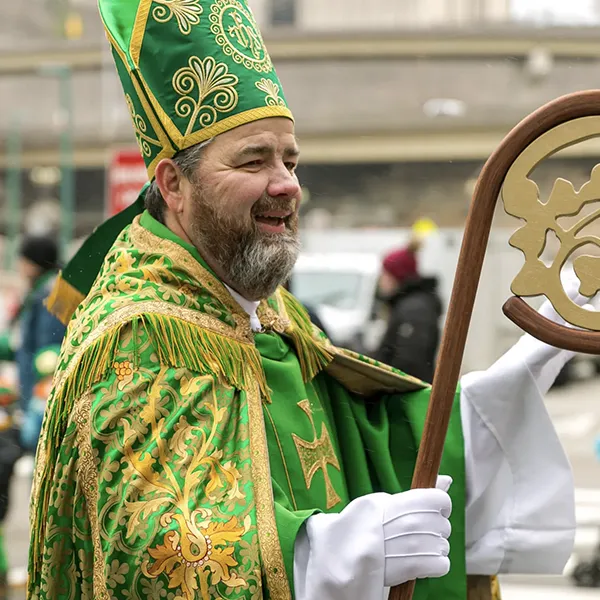
The earliest known St. Patrick’s Day parade in Pittsburgh took place in 1869. Early parades were organized by Irish immigrant societies and Irish Catholic groups to celebrate St. Patrick, the patron saint of Ireland.
In 1871, a group called the Confederated Irishmen of Lawrenceville marched with sashes reading “God Save Ireland.”
Parade Evolution
Many early parades ended at St. Paul’s Cathedral in Oakland, emphasizing the religious aspect of the holiday. During the late 1800s, the parade was both an Irish heritage event for many American newcomers from Ireland, and a way for Irish immigrants to show support for their family and friends and communities on the other side of the Atlantic.
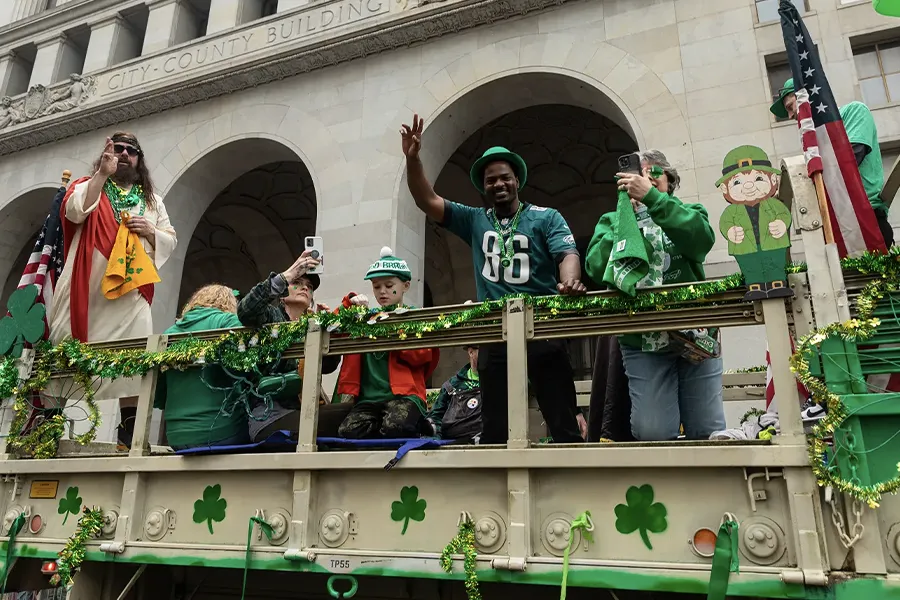
As Pittsburgh grew, so did its Irish-American population and so did the Pittsburgh St. Patrick’s Day Parade. The event gradually shifted from small Irish society marches to a major downtown parade with bands, floats, and civic groups, rivaling similar parades in New York and Chicago.
The route and schedule changed several times over the decades. In the modern era, Downtown Pittsburgh has been its center. The parade is famous for happening “rain, snow, or shine,” and has rarely been disrupted.
In 1903, the parade was canceled due to a severe storm. In 1956, it was officially canceled because of a snowstorm, but still, about 200 people marched in an impromptu parade through nine inches of snow.
Formation of the Irish Society for Education and Charity
Over the course of the 20th Century, parade organizers and leadership changed somewhat, but through it all, Irish Catholic religious, civic and fraternal organizations remained integral to the event’s success. In 1991, the Irish Society for Education and Charity was formed to provide a framework and an infrastructure to assure the parade’s continued success and its future.
The Society brought with it the ability to enhance fundraising efforts for the parade, along with Irish heritage and community causes. It brought with it continuity in leadership and decision-making. And it brought with it the opportunity to expand its focus beyond the parade as appropriate.
Shortly after the Society was formed, in 1993, Pittsburgh experienced what meteorologists described as the “snowstorm of the century” on the same day as the Pittsburgh St. Patrick’s Day Parade. The event stepped off right on schedule with thousands of participants marching and having fun in defiance of the weather, with thousands more along the route cheering them on. This is a testament to the resilience and inherent optimism of the Pittsburgh Irish community. And it’s a reflection of a solid organization behind the parade, which continues to work to assure the preservation of Irish heritage in the Pittsburgh region.
The Society is a 501(c)(3) nonprofit organization.